
Supreme Court Weighs Whether Boulder’s Climate Lawsuit Can Proceed in State Court
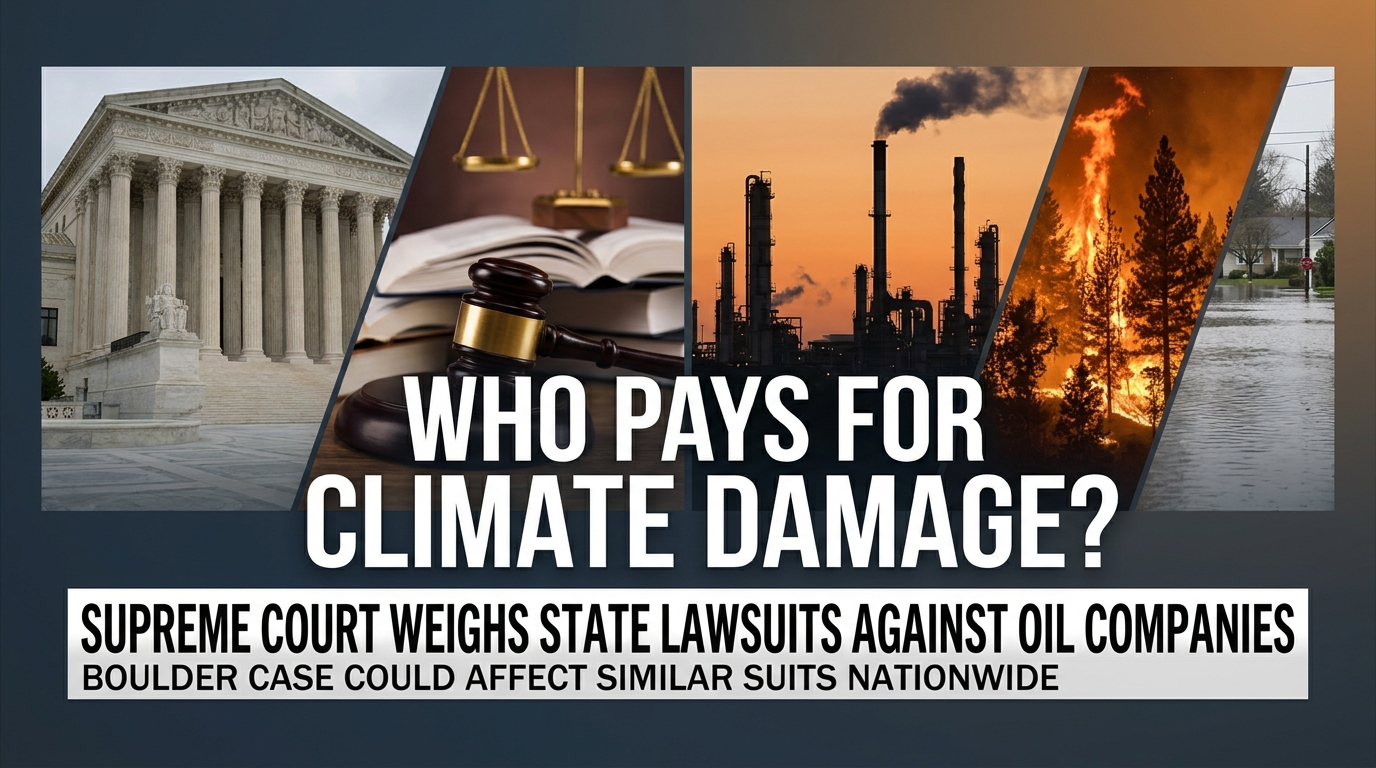
The dispute pits local governments seeking compensation for climate-related harm against oil companies arguing that federal law blocks the claims.
HERE'S WHAT WE KNOW
The dispute involves Boulder’s claims against Suncor and ExxonMobil. The companies argue that federal law prevents the state-law litigation; Boulder disputes that interpretation. The justices are considering both the claims’ legal viability and whether the court may hear the case at this stage.
The U.S. Supreme Court heard arguments Monday, Oct. 5, over whether local governments can pursue state-court claims against oil and gas companies for costs associated with climate change.
The case involves the city and county of Boulder, Colorado, and energy companies Suncor and ExxonMobil. The Supreme Court’s official hearing list confirms that arguments were scheduled for Oct. 5.
According to the Associated Press report, Boulder argues that communities bear substantial costs from worsening floods, wildfires and other climate-related harms and that the companies should share responsibility.
Boulder’s attorney, Kevin Russell, told the justices that the lawsuit seeks accountability for allegedly misleading the public about fossil fuels’ contribution to global warming. He argued that the case does not seek to halt oil and gas production or directly regulate emissions.
The companies dispute the use of state litigation to address a global issue. They argue that the federal Clean Air Act leaves emissions regulation to the federal government and that state-law claims cannot be used to impose broader requirements.
The Trump administration supported the companies’ position, arguing that the lawsuit reaches beyond Colorado’s authority.
The justices questioned both sides about the consequences of allowing the litigation to proceed. Chief Justice John Roberts raised concerns about similar suits spreading nationwide but also noted that state courts routinely handle disputes with effects beyond their borders, according to AP.
Justice Elena Kagan drew comparisons to litigation involving tobacco and opioids. The companies’ attorney, Kannon Shanmugam, argued that climate-related harms present a different problem because they are distributed globally.
The court is also considering whether it has jurisdiction to resolve the dispute at this stage. That question could allow the justices to avoid deciding the broader legal issues immediately.
Justice Samuel Alito did not participate after recusing himself. AP reported that an evenly divided court would leave the Colorado Supreme Court’s decision allowing the case to proceed in place.
No ruling was announced in the report. The arguments concern whether the lawsuit can move forward, not a final determination that the companies owe damages.
WHAT IT MEANS
The outcome could influence similar climate lawsuits brought by other state and local governments. It does not establish a financial award for Frederick County or any other Maryland community, and the supplied report identifies no direct Frederick County role in the case.
Original reporting referenced by Everything Frederick:
Associated Press — Reporting by Lindsay Whitehurst and Matthew Daly, with contributions from Nicholas Riccardi, as supplied. Argument date checked against the U.S. Supreme Court hearing list. →Want more Frederick updates like this?
Get local alerts, event reminders, restaurant openings, sports news, giveaways, live show updates, and community stories from Everything Frederick. Want to talk about what’s happening? Join the Frederick Connect community too.