

Frederick explores property-tax changes that could shift who pays
Council members reviewed separate residential rates, a tiered system and land-value taxation. The discussion did not establish a new tax structure.
HERE'S WHAT WE KNOW
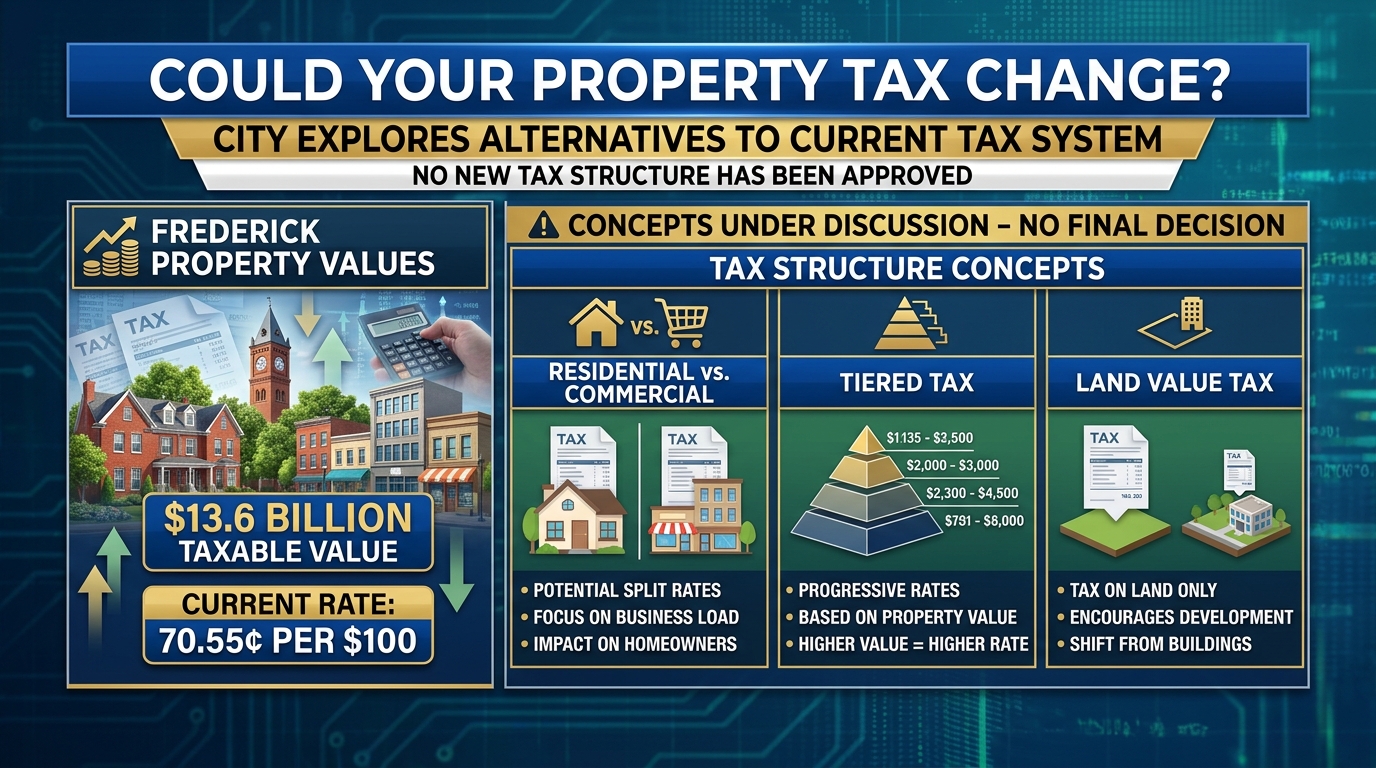
The Sept. 24 work session examined three alternative property-tax approaches. The standard city rate is 70.55 cents per $100 of assessed value, with a separate structure for habitually vacant property. The models seek to maintain overall city revenue while changing how the burden is distributed. Tiered taxation raises legal and billing questions. No new tax structure is established by the supplied reporting.
Frederick City Council members began examining alternatives to the city’s property-tax structure Sept. 24, weighing approaches that could change individual bills without increasing total city revenue.
Chief Administrative Officer Katie Barkdoll presented three broad options: different rates for residential and nonresidential property, a tiered system based on property value, and taxation focused more heavily on land rather than buildings.
The discussion was intended to identify which ideas council members want staff to investigate further, according to The Frederick News-Post. It was not an announcement that a replacement tax system had been adopted.
Frederick’s standard city property-tax rate is 70.55 cents per $100 of assessed value. Habitually vacant properties are subject to a different structure, with rates varying according to the length of vacancy.
The city’s taxable property base totals approximately $13.6 billion. The News-Post reported roughly $89 million in property-tax revenue for fiscal 2026 and about $95.6 million budgeted for fiscal 2027.
One approach would separate residential and nonresidential rates. That could reduce bills for homeowners, but the size of the residential tax base creates a tradeoff. Residential property, including apartments, accounts for about 73% of taxable value, according to the presentation as reported by the newspaper.
Maintaining the same overall revenue while reducing residential rates would therefore require higher rates on nonresidential property. The approach would redistribute the burden rather than remove the city’s need to collect revenue.
A second option would apply a tiered structure intended to lower taxes on less valuable properties while increasing rates on higher-valued properties.
Barkdoll identified significant obstacles. State requirements concerning uniform taxation of similar properties could require a change in state law, and administering a tiered system would complicate billing. Frederick County currently handles the city’s property-tax billing and collection; bringing those functions into city government would require substantial investment, she said.
The third approach would shift taxation toward the value of land. Under a pure land-value tax, buildings and improvements would not be taxed. A hybrid system would tax land at a higher rate and structures at a lower rate.
That distinction means a lower-priced home does not automatically benefit. A property with relatively valuable land and a modest structure could face a higher bill than a property with a more valuable building on comparable land.
The city’s preliminary analysis illustrates that concern: its presentation says modeled land-value approaches generally increase taxes in Hillcrest and Amber Meadows while reducing them in Worman’s Mill and Dearbought. The city cautions that the modeling does not capture every assessment phase-in, exemption, credit or individual circumstance.
Council President César Díaz characterized the land-value approach as a potential driver of gentrification. Council Member Joe Adkins warned that it could encourage redevelopment or teardowns in older communities, with harmful unintended consequences.
Those remarks express concerns about possible effects, not findings that such changes would necessarily occur.
Díaz asked to see additional alternatives as the conversation continues. The supplied reporting and meeting materials do not establish a final choice, implementation date or new rate.
WHAT IT MEANS
Revenue-neutral does not mean every property owner would pay the same amount as before. Any alternative could lower some bills and raise others. The city’s land-value modeling is preliminary, so neighborhood examples should not be treated as an individual tax estimate or an approved increase.
Original reporting referenced by Everything Frederick:
The Frederick News-Post — Reporting by Katelynn Winebrenner, from the supplied news file. Additional verification: City of Frederick Sept. 24, 2026 agenda and Real Property Tax presentation. →Want more Frederick updates like this?
Get local alerts, event reminders, restaurant openings, sports news, giveaways, live show updates, and community stories from Everything Frederick. Want to talk about what’s happening? Join the Frederick Connect community too.