
Frederick Draft Would Expand Affordable-Housing Program to Smaller Developments
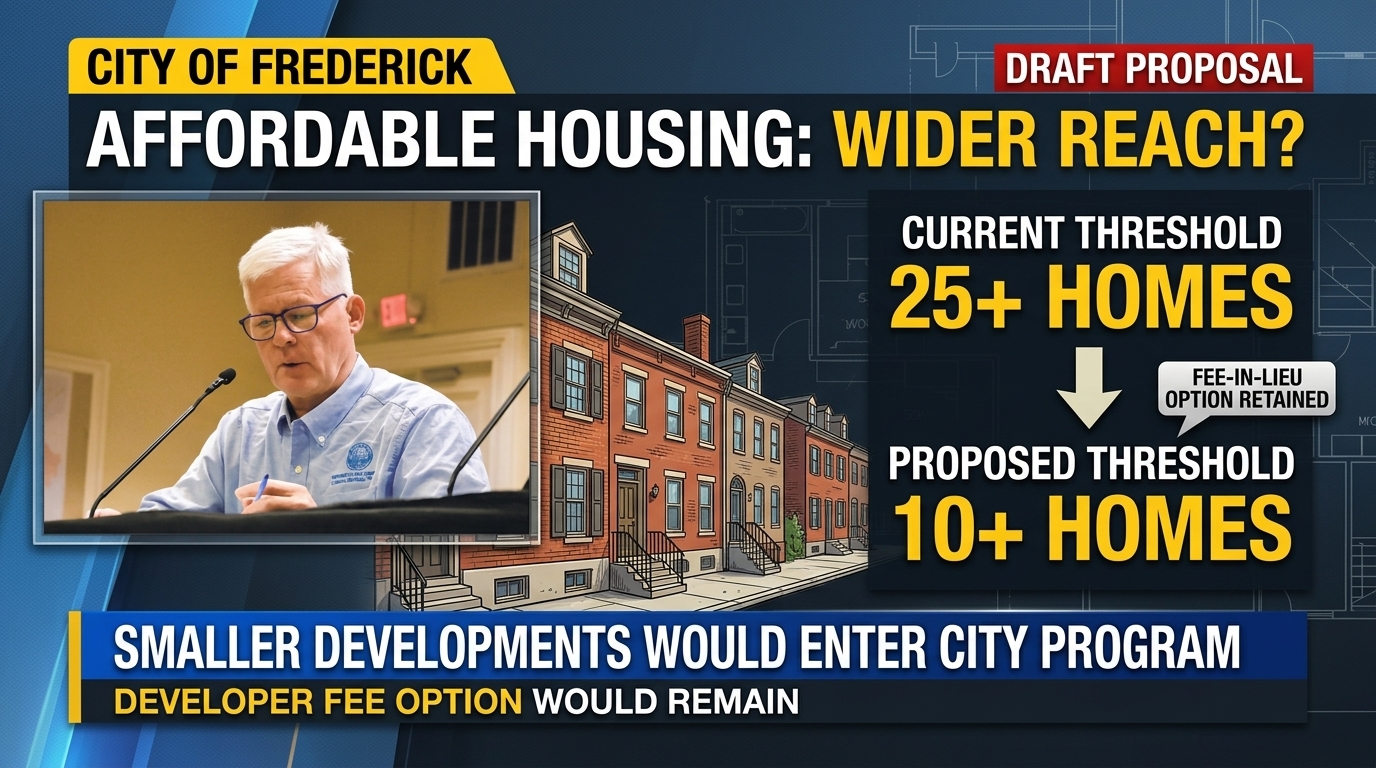
Brehm and Shackelford propose lowering the project threshold from 25 units to 10 while retaining developers’ fee-in-lieu option.
HERE'S WHAT WE KNOW
The draft would lower the program’s project threshold from 25 units to 10. The existing 12.5% set-aside requirement can be met through a fee alternative, which the council members propose retaining. The draft also addresses fully affordable projects and local income benchmarks. No adoption or effective date is reported.
More residential developments could fall under Frederick’s moderately priced dwelling unit program under an update being drafted by City Council members Peter Brehm and Derek Shackelford.
The proposal would lower the project-size threshold from 25 housing units to 10, following a recommendation from the mayor’s affordable housing task force, according to The Frederick News-Post.
The current program requires qualifying developments to set aside at least 12.5% of their units for controlled-price sale or rental to low- and moderate-income households. Developers can instead pay a fee, an option the council members intend to retain.
The draft is still being developed with city staff. It is not an adopted change to the program.
Brehm and Shackelford said fee revenue helps the city support other affordable-housing efforts. Shackelford pointed to assistance for Low-Income Housing Tax Credit projects and low-interest loans for developers pursuing the city’s goals.
Brehm said additional incentives could encourage builders to provide units within their developments without eliminating the fee option. He cited the economic difficulty of producing those units.
The draft also clarifies that moderately priced dwelling units are homes built within market-rate developments and sold or rented through the city program. It would exempt developments that are entirely affordable and calls for a separate incentive program for those projects.
Another part of the discussion concerns how the city measures the income levels used to define affordability.
Frederick currently relies on a federal housing benchmark based on the Washington-area median income. The preliminary proposal would shift toward a Frederick County-specific measure, while Shackelford advocated eventually developing a city-specific standard.
The newspaper cited a Washington-area median family income figure and a Frederick County median household income estimate. Those are different statistical measures and should not be treated as interchangeable or used to calculate new eligibility limits from this draft.
Brehm agreed that local data should inform the policy. The two council members will continue refining the proposal with staff.
For residents, the central question is whether expanding the program to smaller developments, alongside incentives and fee-funded projects, would produce more housing they can afford. The final requirements and income standards remain to be determined.
WHAT IT MEANS
Smaller developments could become subject to the program if the update is approved, but retaining the fee option means inclusion would not necessarily produce affordable units in every qualifying project. Residents’ eligibility and controlled prices cannot be determined until the final income methodology and rules are established.
Want more Frederick updates like this?
Get local alerts, event reminders, restaurant openings, sports news, giveaways, live show updates, and community stories from Everything Frederick. Want to talk about what’s happening? Join the Frederick Connect community too.