
Impact-Fee Relief Bill Runs Out of Time After 4–3 Council Amendment
A proposed exemption for certain home replacement and rehabilitation projects cannot reach a final vote this year after a divided council added new requirements.
HERE'S WHAT WE KNOW
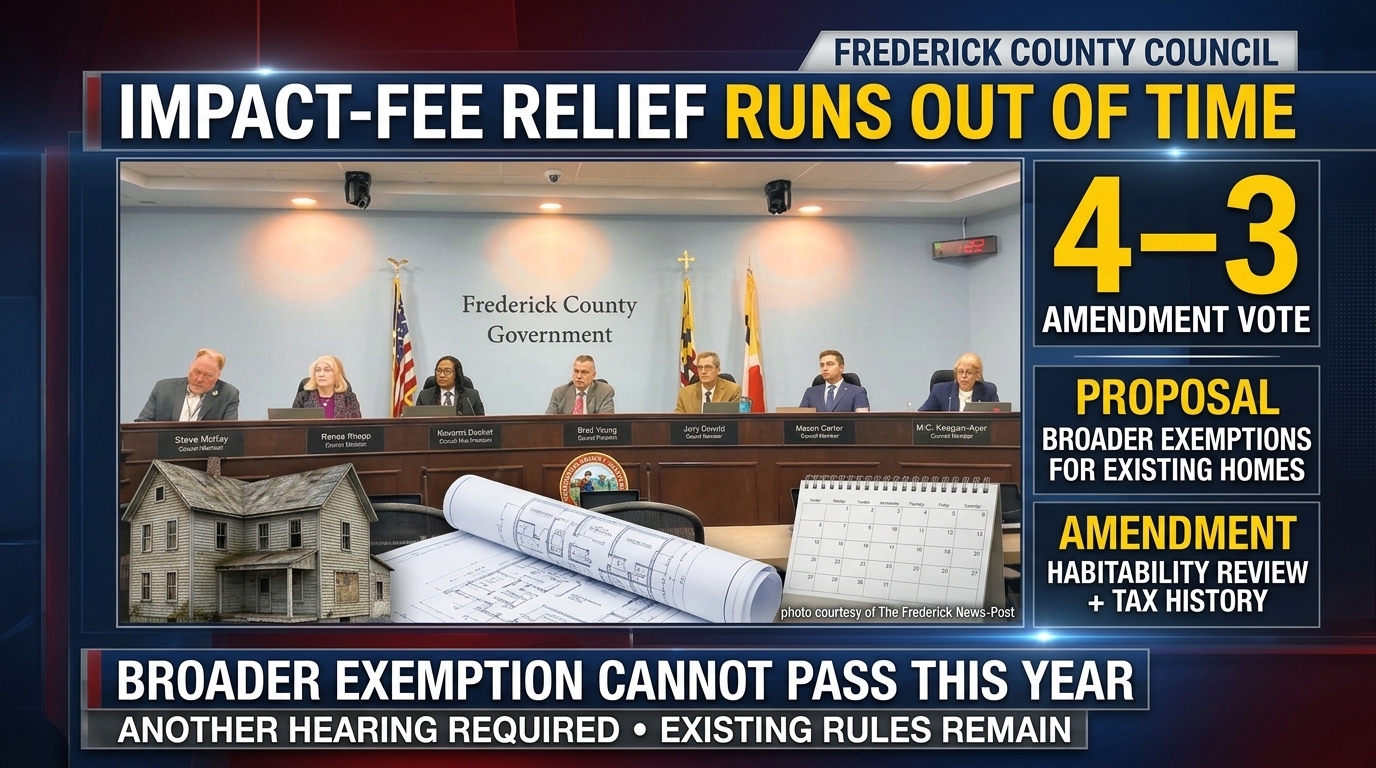
The amendment passed 4–3, but the amended bill cannot complete the required hearing and voting process before this year’s legislative calendar runs out. McKay sought to remove the continuous habitability and occupancy requirement tied to July 1, 2001. County impact fees fund school and library capacity; fiscal 2027 rates range from $9,995 to $22,881 per new residential unit, depending on the type.
A Frederick County proposal to broaden impact-fee exemptions for certain residential projects has run out of time in the council’s election-year calendar.
The measure cannot complete the remaining legislative process this year after council members approved an amendment Tuesday, according to The Frederick News-Post. The amended bill would need another public hearing before a final vote, and there is not enough time left to hold it.
Council Member Steve McKay proposed removing a requirement that a home being replaced must have been continuously habitable and occupied from July 1, 2001, through the replacement building-permit application. Current rules also exempt projects that enlarge an existing dwelling without adding units.
McKay argued that a property’s history of being taxed as a residence should carry more weight than whether it has remained habitable. His proposal did not specify a time period for reviewing that taxation history.
Council Member M.C. Keegan-Ayer’s amendment would require county staff to determine habitability and require evidence of prior residential use, habitability and taxation, along with the property’s tax history for the preceding 10 years.
The amendment passed 4–3. Keegan-Ayer, Council Vice President Kavonté Duckett and members Jerry Donald and Renee Knapp supported it. Council President Brad Young, Mason Carter and McKay opposed it.
The disagreement centers on what impact fees are meant to cover. Keegan-Ayer said a long-uninhabitable structure may not be counted as housing that could generate students. Restoring that property to residential use could create demand for school capacity, even if the owner has continued paying property taxes.
McKay countered that a home can change from a childless household to a family with children without triggering a new impact fee. He also objected that amending the measure at this point would prevent it from passing.
Keegan-Ayer denied trying to kill the bill and said the council still had work to do before its term ended. McKay said he had submitted the proposal to the administration in March, waited three months for comments and wanted staff input before introducing it.
For fiscal 2027, county impact fees are $20,111 for a new detached single-family home, $22,881 for a townhouse or duplex and $9,995 for other residential units. The money supports additional school and library capacity.
The exemption proposal’s failure to advance this year leaves the existing requirements in place.
WHAT IT MEANS
Owners planning to replace or rehabilitate an existing dwelling will not receive the broader exemption through this bill this year. The debate leaves unresolved how the county should weigh a property’s tax history against the potential demand created when housing becomes habitable again.
Want more Frederick updates like this?
Get local alerts, event reminders, restaurant openings, sports news, giveaways, live show updates, and community stories from Everything Frederick. Want to talk about what’s happening? Join the Frederick Connect community too.