
Frederick seeks more tax options, saying flexibility could ease property taxes
City leaders asked state lawmakers to support revenue reforms, while legislators questioned whether new options could increase residents’ overall burden.
HERE'S WHAT WE KNOW
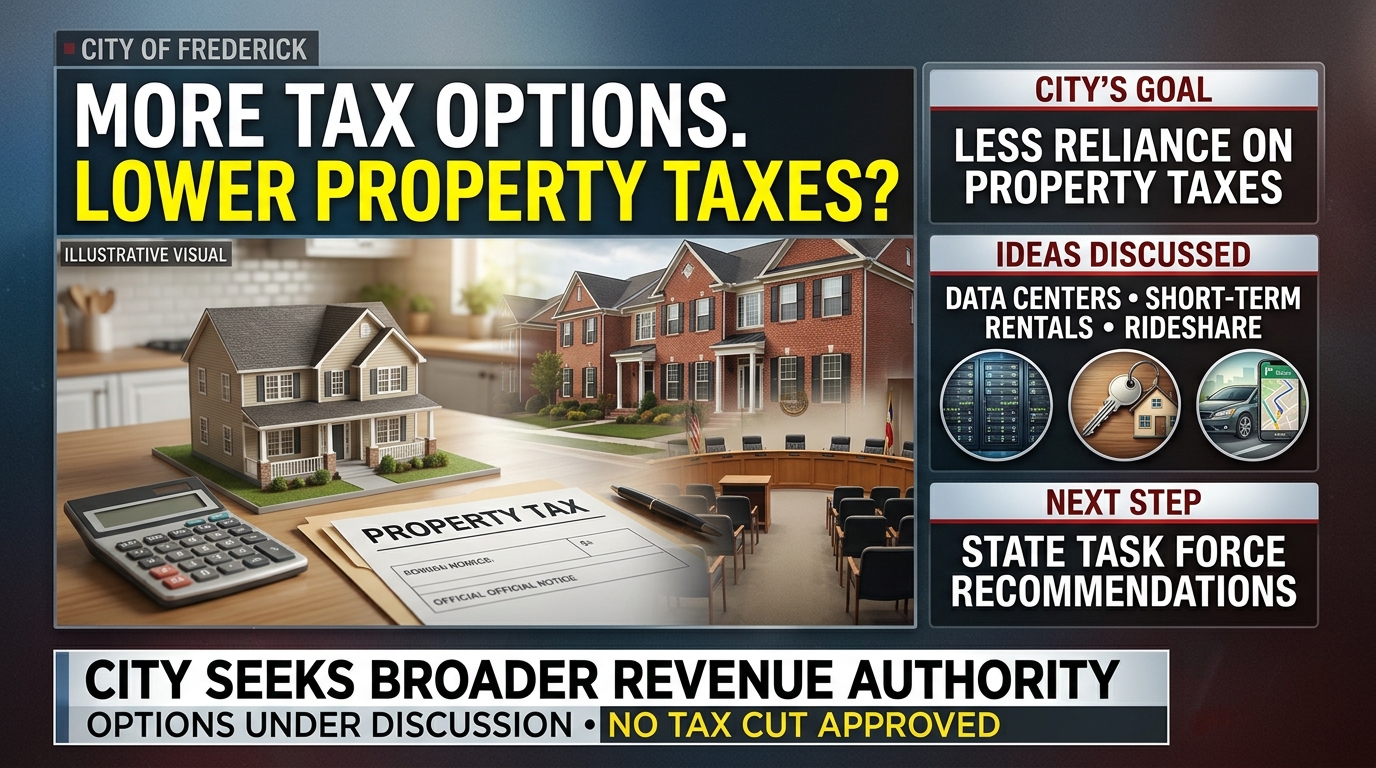
Frederick asked lawmakers to support more flexible local revenue authority without endorsing a particular city tax. Lewis Young said she plans data center personal-property-tax legislation; other ideas included short-term rentals and rideshare revenue. No tax change or property-tax reduction was approved in the reported discussion. Task-force recommendations are still pending.
Frederick leaders want more ways to fund city services—and say that flexibility could create room to lower property taxes. Some state lawmakers are questioning whether the result would instead be a heavier overall tax burden.
At a joint meeting Tuesday, the mayor and City Council asked local legislators to support modernizing municipal and county revenue authority ahead of the General Assembly session in January, The Frederick News-Post reports.
The city did not endorse a specific new tax. It is awaiting recommendations from a state task force examining local revenue structures.
Mayor Michael O’Connor said the city relies too heavily on property taxes and lacks other options to meet service costs. Council Member Derek Shackelford also called for greater flexibility.
O’Connor and Sen. Karen Lewis Young serve on the task force. Lewis Young described its purpose as giving local jurisdictions choices suited to their circumstances, rather than setting statewide tax policy or solving the state’s budget deficit.
Lewis Young said she plans to introduce legislation enabling local jurisdictions to levy personal property tax on data centers. That is a proposed legislative step, not an enacted change described in the report.
Council Member Peter Brehm also suggested authority to tax short-term rentals and increase revenue from rideshare applications.
Sen. William Folden expressed concern about expanding taxation during an affordability crisis. He also questioned the task force’s political representation, noting that its four state legislative members are Democrats.
Del. April Miller raised concerns about business competitiveness, growth and the combined state and local burden. She asked whether greater local taxing power might be accompanied by reduced state financial support. O’Connor said that was his expectation, not an announced funding decision.
The mayor expects recommendations spanning multiple years. The report lists upcoming task-force meetings on Oct. 30 and Nov. 30.
For now, the discussion sets a legislative priority. It does not establish a new city tax, a property-tax cut or a guarantee that any alternative revenue would reduce a household’s total bill.
WHAT IT MEANS
More taxing authority could change how the city distributes the cost of services, but authority alone would not guarantee savings. Residents would need specific rates, revenue estimates and property-tax commitments to evaluate a future proposal.
Want more Frederick updates like this?
Get local alerts, event reminders, restaurant openings, sports news, giveaways, live show updates, and community stories from Everything Frederick. Want to talk about what’s happening? Join the Frederick Connect community too.