AI in the Classroom: Maryland School Board Candidates Weigh Learning Against Risk
Candidates debate critical thinking, privacy and age limits as school systems develop rules for artificial intelligence.
HERE'S WHAT WE KNOW
Candidates differ on student AI bans, age restrictions and how much classroom use is appropriate. The report describes district policies addressing privacy, academic integrity and human review of AI-generated material. The statewide survey is not a statement of Frederick County’s current student AI rules.
Artificial intelligence is becoming a school board issue across Maryland, with candidates weighing how to prepare students for new technology without allowing it to replace the work of learning.
A Capital News Service report by Hannah Harris examines responses to a Local News Network candidate survey as school systems develop and implement AI policies. More than 135 candidates are running in school board elections across Maryland’s 24 districts, according to the report.
The report says the General Assembly passed the Artificial Intelligence Ready Schools Act in April, requiring public school systems to adopt plans for integrating AI into K–12 education by the beginning of October. Survey responses arrived at different stages of local policymaking, meaning some candidates answered before their district adopted its rules.
One recurring question was whether AI helps students develop skills or lets them skip that process.
Baltimore County incumbent Maggie Litz Domanowski said students should do their own thinking and use the technology to support learning. Baltimore City candidate Jamar Day warned that relying on generated essays and answers could weaken critical thinking and creative writing.
Other candidates argued that avoiding AI entirely would leave students unprepared for college and employment. Wicomico County candidate David Plotts emphasized teaching students to check information, recognize bias, protect personal data and understand the tools’ limitations.
District policies described in the report reflect those competing priorities. Baltimore City permits uses such as translation, study support and brainstorming while stating that AI should not replace approved curriculum. Wicomico requires qualified instructional staff to review AI-generated educational content and assessments before use. Caroline County’s rules permit learning and accessibility support while prohibiting uses such as plagiarism, cyberbullying and false documentation.
Age limits and foundational skills also divide candidates. Montgomery County candidate Cassandra Sung proposed grade-level guidance and AI-free settings where students could demonstrate basic skills first. Cecil County candidate Brian Hampton supports a student AI ban in kindergarten through fifth grade and is open to extending it through eighth grade.
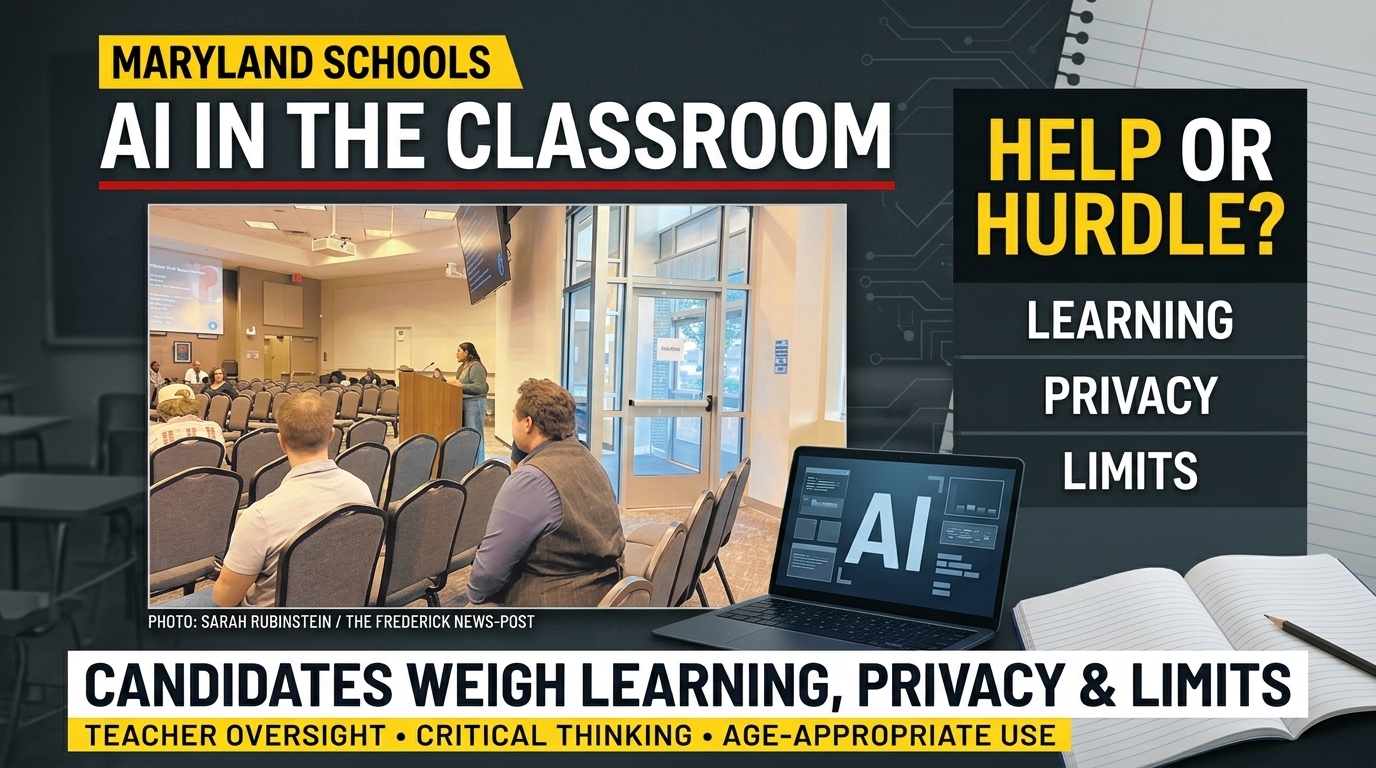
For Frederick County readers, the statewide debate has a local connection: the report includes a photograph of Urbana High School teacher Aubrey Lynch advocating a full student AI ban at an Oct. 7 school board meeting. That advocacy is not evidence that Frederick County adopted such a ban.
Across the survey, candidates repeatedly called for human oversight, teacher preparation and protection of student information. The choices ahead concern not simply whether schools use AI, but when, for what purpose and under whose supervision.
WHAT IT MEANS
Families will need to distinguish statewide expectations from their own school system’s approved practices. The debate also puts implementation responsibilities on future board members: training educators, evaluating tools and checking whether AI supports students’ own learning.
Want more Frederick updates like this?
Get local alerts, event reminders, restaurant openings, sports news, giveaways, live show updates, and community stories from Everything Frederick. Want to talk about what’s happening? Join the Frederick Connect community too.