Third-Party Candidates Challenge Exclusion From Maryland Governor’s Debate
Green Party nominee Andy Ellis and Working Class Party nominee Cathy White say voters should hear from all four candidates on the ballot.
HERE'S WHAT WE KNOW
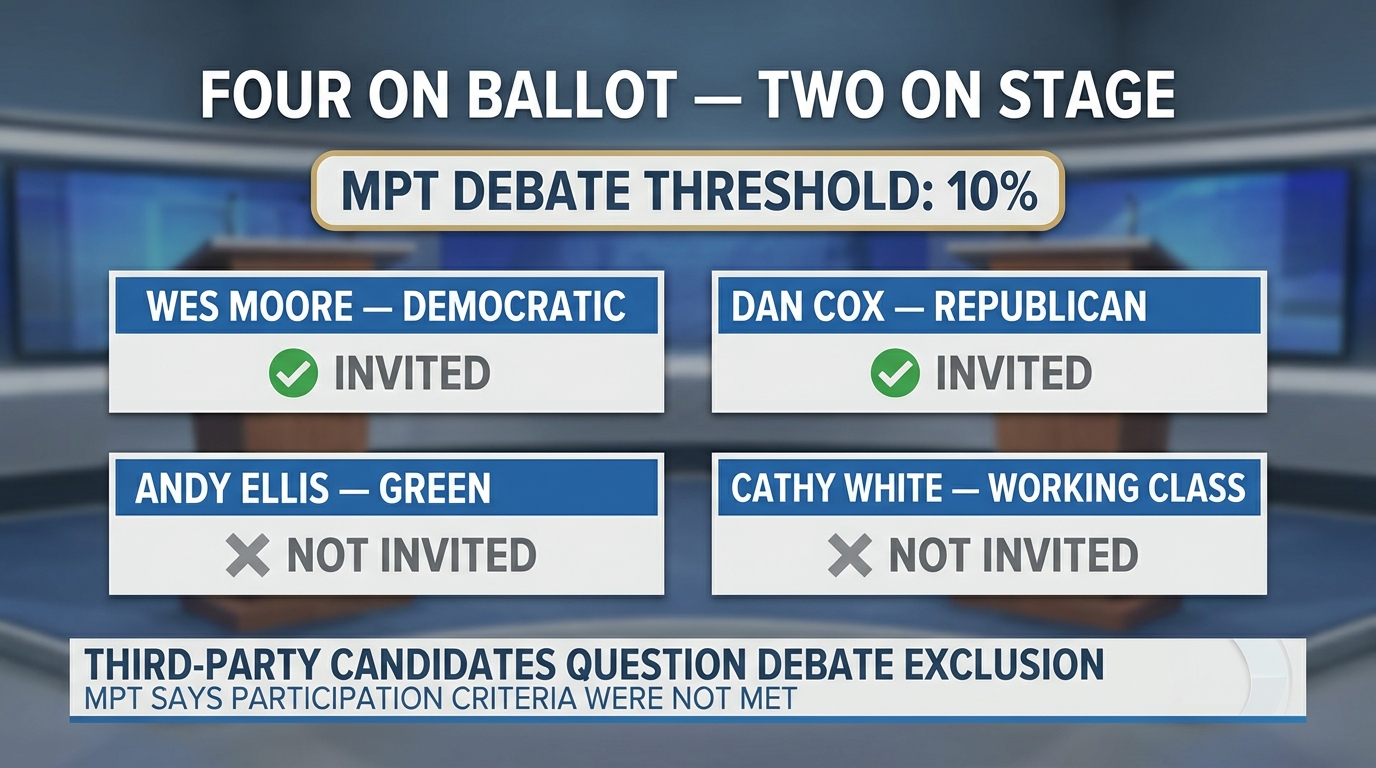
Four candidates are on the gubernatorial ballot, according to Maryland Matters. MPT says Moore and Cox met its debate criteria; Ellis and White object to their exclusion. The broadcaster cites a 10% polling threshold and other indicators of campaign significance.
Two candidates on Maryland’s gubernatorial ballot are challenging their exclusion from the campaign’s only scheduled debate, arguing that voters should be able to compare all four contenders on the same stage.
Green Party nominee Andy Ellis and Working Class Party nominee Cathy White have sought inclusion in the Maryland Public Television debate scheduled for Tuesday, Oct. 6. MPT says Democratic Gov. Wes Moore and Republican nominee Dan Cox met its participation requirements, according to Maryland Matters.
The dispute centers in part on a polling threshold. MPT says candidates must reach 10% to qualify for its broadcast debates. Ellis argues that this is difficult for third-party candidates when polls often ask voters only about the major-party nominees.
White likewise says ballot-qualified candidates should have an opportunity to present their positions alongside the better-funded campaigns.
MPT told Maryland Matters that its content division, news and public affairs team and broadcast partners organize debates to serve the public interest. The broadcaster said its leadership reviews participation guidelines approximately every four years and considers public feedback.
In correspondence described in the report, MPT told Ellis he had not demonstrated a sufficiently significant candidacy through polling or other indicators such as prior voter support, media attention, campaign resources, volunteers or event attendance.
Ellis obtained public records and questioned why MPT invited all nine Republican primary candidates earlier in the year while limiting participation in the general-election debate. He said he supports broad primary participation and wants the same approach applied to the four candidates on the November ballot.
He also raised concerns about campaign contributions to Moore by the chair of MPT’s governing commission and the chair’s wife. MPT responded that the commission does not plan or make decisions about debates and said the contributions were lawful. The report does not establish that the donations determined debate access.
Political scientist Todd Eberly of St. Mary’s College of Maryland told Maryland Matters that decisions about debate participation do not necessarily demonstrate viewpoint discrimination, noting that media organizations regularly exercise editorial judgment.
Both excluded candidates said debates still offer an important opportunity for voters to hear candidates respond to one another. Ellis said he did not plan to force his way onto the stage or organize a competing protest.
WHAT IT MEANS
For Frederick County voters, the scheduled debate offers a comparison of the participating candidates but does not represent the full ballot. The disagreement concerns access to the debate stage, not whether Ellis and White qualified to run in the election.
Original reporting referenced by Everything Frederick:
Maryland Matters — Reporting by Pera Onal, with contributions from Bryan P. Sears. Adapted from the supplied article. →Want more Frederick updates like this?
Get local alerts, event reminders, restaurant openings, sports news, giveaways, live show updates, and community stories from Everything Frederick. Want to talk about what’s happening? Join the Frederick Connect community too.