
Holtzinger says he would push to shrink Frederick County data center zone by about 39%
Republican county executive candidate Jeff Holtzinger says he would ask the County Council to reduce the Critical Digital Infrastructure overlay from 2,615 acres to the smaller map recommended by the Planning Commission.
HERE'S WHAT WE KNOW
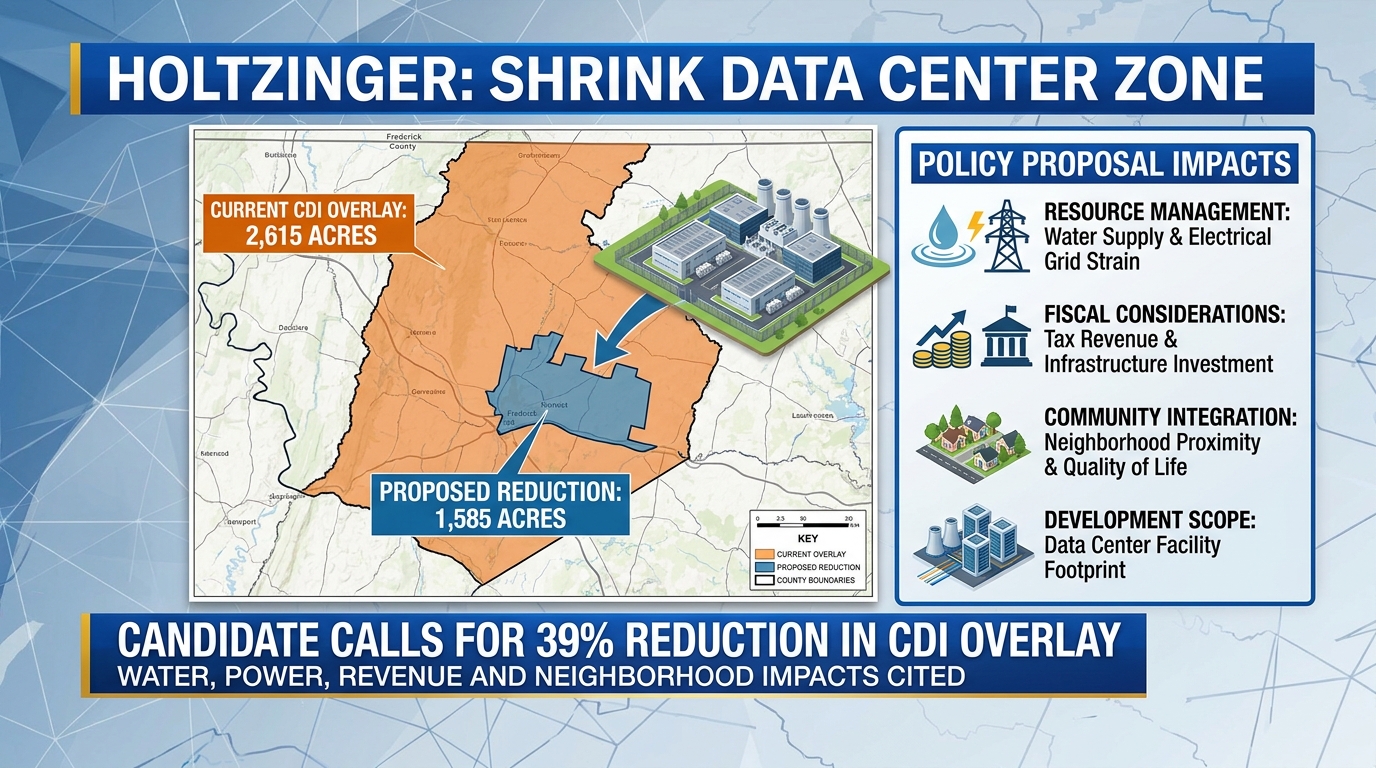
Holtzinger wants the CDI overlay reduced from 2,615 acres to 1,585 acres. He cannot change the zoning map unilaterally as county executive. His stated concerns include water supply, tax-revenue reliability, neighborhood impacts and electricity demand. He says he would initially avoid building new permanent spending around projected data center revenue. Holtzinger did not sign the referendum petition. He says he would lean toward supporting a charter change allowing zoning-map referendums. Frederick County currently has a pause on new data center applications through July 1, 2027.
Republican Frederick County executive candidate William “Jeff” Holtzinger says he would push to reduce the county’s designated data center zone by roughly 39% if elected in November.
Holtzinger told The Frederick News-Post that he would ask the County Council to adopt the 1,585-acre Critical Digital Infrastructure overlay map recommended by the county Planning Commission in 2025 rather than the 2,615-acre map ultimately approved by the council.
Holtzinger and incumbent Democrat Jessica Fitzwater are the active major-party candidates for Frederick County executive in the Nov. 3 general election, according to the Maryland State Board of Elections.
The final CDI overlay includes the former Eastalco industrial property near Adamstown as well as roughly 1,100 acres of surrounding agricultural land.
Holtzinger said he has four major concerns about the county’s current approach: whether enough water is available for full build-out, whether projected tax revenues will prove reliable, impacts on nearby neighborhoods and whether data center power demand could affect electricity bills.
Water supply
Holtzinger, a civil engineer and former Frederick mayor, said he is concerned about the amount of water that could be required if the entire data center zone were developed.
He cited the regional water withdrawal arrangement that allows Frederick County and the City of Frederick to draw an average of 16 million gallons per day from the Potomac River and Linganore Creek, with portions already committed to the city and Fort Detrick.
His concern is that data centers and other development could increase demand enough to put pressure on the remaining allocation.
Data center revenue
Holtzinger also said he would be cautious about creating permanent new county spending based on projected data center tax revenue.
He argued that changes in technology could eventually reduce the amount of development or infrastructure needed, leaving the county with less revenue than originally forecast.
Instead, he said he would initially favor allowing the revenue stream to stabilize before considering using some of it for property-tax relief.
Neighborhood impacts
Holtzinger said he believes current landscaping and screening around some construction sites are insufficient to protect nearby residents from noise, light and construction dust.
He acknowledged that he has not read the county’s full data center regulations but said he would review and enforce those standards if elected and would seek voluntary improvements from developers where residents continue to experience problems.
Electricity concerns
Holtzinger also said he wants the county to examine whether large-scale power demand from data centers could affect local utility rates.
Frederick County does not regulate the regional electric grid, but Holtzinger said he believes county approvals should consider projected power demand and potential effects on customers.
Frederick County currently is not accepting new applications for new data center developments, and Fitzwater has extended the pause through July 1, 2027.
Referendum and charter
Holtzinger did not sign this year’s petition seeking a referendum on the CDI map.
More than 21,000 registered voters signed the petition, but a Frederick County judge ruled that the zoning-map ordinance could not be challenged through referendum under the county charter. The Maryland Supreme Court upheld that decision.
Holtzinger said he would lean toward supporting a future charter amendment making zoning-map ordinances eligible for referendum, although charter amendments would have to originate with the County Council and ultimately be approved by voters.
WHAT IT MEANS
Holtzinger’s proposal would move Frederick County closer to the smaller data center footprint originally recommended by the Planning Commission.
The county executive could not make that change alone. Any change to the zoning map would require action by the County Council.
For voters, the proposal provides a concrete point of comparison in the county executive race over how much land should remain eligible for future data center development and what safeguards should accompany that growth.
Original reporting referenced by Everything Frederick:
The Frederick News-Post — Reporting by Erik Anderson; Maryland State Board of Elections; Frederick County Government →Want more Frederick updates like this?
Get local alerts, event reminders, restaurant openings, sports news, giveaways, live show updates, and community stories from Everything Frederick. Want to talk about what’s happening? Join the Frederick Connect community too.