
The Battle Over Frederick’s Data Centers: What the Record Shows, What It Could Cost, and What Taxpayers Deserve to Know
Analysis: Court filings and public announcements raise questions about executive authority, transparency and financial exposure—but allegations are not findings, and proposed benefits are not cash already lost.
HERE'S WHAT WE KNOW
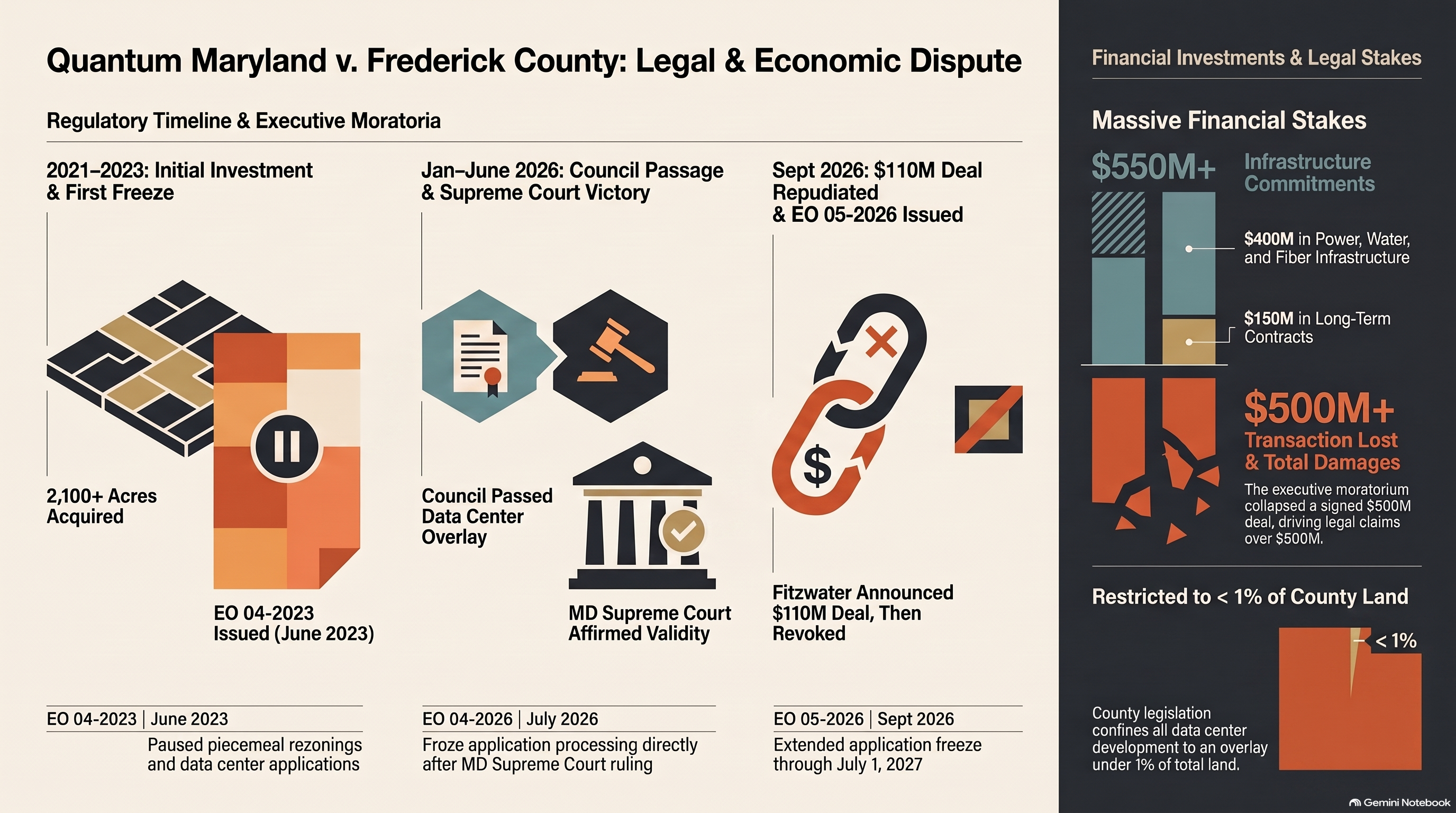
Quantum’s Oct. 8 complaint challenges the county’s moratorium and seeks damages and an order restoring access to the development process. The county publicly disclosed DAI’s involvement July 1 and announced rejection of the proposed benefits agreement Sept. 14. The complaint requests damages exceeding $75,000 and separately alleges liability exceeding $500 million; neither figure is a court award.
Frederick County’s data center dispute is now a fight over executive authority, a rejected community benefits proposal and potentially substantial financial claims. Residents deserve a clear explanation of the decisions involved—and an accurate distinction between documentary evidence, allegations and costs that have actually been established.
Quantum Maryland, LLC filed its complaint Oct. 8 in Frederick County Circuit Court, naming the county, County Executive Jessica Fitzwater in her official and individual capacities, and the Planning Commission. The case concerns development at the Frederick Digital Campus near Adamstown and the county’s pause on new data center applications.
This analysis draws on the complaint, its attached Exhibit A, official county announcements and the Maryland Supreme Court’s referendum order. A complaint documents what a party alleges; it does not establish that those allegations are true.
1. The transparency question: What was announced, and what records remain unavailable?
On June 30, the Maryland Supreme Court affirmed a judgment preventing the county’s data center zoning ordinance from going to referendum. That order addressed the referendum dispute, not the legality of a later executive moratorium.
An email reproduced in Exhibit A shows Pat Murray contacting DAI that evening about moving forward with Catellus negotiations. He sought language describing DAI’s experience for an announcement planned the next day.
The county did publicly announce the negotiations and DAI’s role on July 1. Its statement also announced the application pause and described public engagement plans. The record therefore does not support suggesting that the existence of the negotiations or the adviser’s involvement was kept secret.
Access to the underlying correspondence is a separate issue. Exhibit A contains a September response to a request for emails involving Murray and Catellus executive Michael Kuykendall. The response lists a staff rate of $58.42 per hour, credits two free hours and requires a $116.84 deposit, with a balance due before records are released.
The deposit is not identified as the complete bill. Nor does the fee notice alone establish unlawful withholding or deliberate obstruction. It does, however, document a cost attached to obtaining records about a consequential public negotiation.
The question for residents: What negotiation records and adviser costs can the county proactively disclose, and what specific reasons support any material it withholds?
2. The authority question: Can an executive pause this process?
Quantum’s central legal argument is that Fitzwater used executive orders to suspend access to a land-use process established through County Council legislation.
The company argues that the County Charter does not give the executive authority to override those enactments. Its requested relief includes a declaration that Executive Order 05-2026 is unlawful and an order restoring access to the development review process.
Fitzwater disputes the lawsuit’s allegations and has defended the pause as a measure to protect the community. As reported by The Frederick News-Post, she has pledged to fight the case.
The scope of the pause matters. The county’s July 1 announcement described a halt to accepting and processing new applications for critical digital infrastructure facilities and substations. It was not a blanket announcement stopping all previously approved construction.
Whether that restriction exceeds executive authority is a disputed legal issue. Calling it an established bypass of county law would adopt the plaintiff’s position before that issue has been resolved in the materials reviewed.
The question for residents: What specific legal authority does the county rely on, and how does it reconcile the executive orders with the Council’s enacted development framework?
3. The 13-day reversal: What changed?
A proposed community benefits package was announced Sept. 1. Catellus described more than $110 million in commitments, including school renovations, parks and recreation, workforce training, agricultural preservation and public-safety equipment.
The package was still a proposal requiring further action. It was not $110 million already deposited in county accounts.
On Sept. 14, the county announced that Fitzwater had rejected the application for the development rights and responsibilities agreement and extended the application pause until July 1, 2027.
Her stated concern, described in the supplied News-Post reporting, was that the benefits came with unacceptable restrictions on future county regulation. Quantum disputes that characterization of the proposed agreement.
Paragraph 91 of the complaint alleges, on information and belief, that unfavorable polling preceded the decision. It also alleges an election-related conversation with a campaign donor. Those claims do not independently establish what motivated the reversal.
The question for residents: What public feedback, legal analysis or proposed contract provisions drove the rejection, and when did the administration conclude that those concerns outweighed the benefits it had promoted?
4. The financial question: What could taxpayers actually owe?
Three different figures must be kept separate.
First, Quantum alleges that the moratorium derailed a private transaction valued at more than $500 million. A transaction’s value is not automatically the amount of recoverable damages or a measure of lost county tax revenue.
Second, the approximately $110 million benefits proposal represented prospective developer commitments. Its rejection does not mean the county spent or lost an equivalent amount of cash already in its possession.
Third, the complaint’s formal request seeks compensatory damages exceeding $75,000, to be proven at trial, including lost transactions and continuing carrying costs. It also seeks attorney’s fees, costs and interest. The $75,000 wording is not a ceiling: paragraph 124 separately alleges that defendants’ liability already exceeds $500 million.
Neither statement is a court award. The materials reviewed do not establish a damages judgment, a quantified county defense budget or the portion of any eventual liability that public funds would bear.
The question for residents: Has the county assessed defense expenses, insurance or other coverage, and possible financial outcomes—and what can it disclose about those risks?
Residents can disagree about data centers while expecting clear answers about government decisions. The public interest is served by a documented explanation of authority, negotiations, changing decisions and financial exposure. Those questions are serious enough without treating either the developer’s allegations or the administration’s assurances as the final word.
WHAT IT MEANS
The dispute warrants public scrutiny of the county’s legal reasoning, decision-making and financial planning. A meaningful accounting must distinguish the value of private transactions, proposed community benefits, litigation claims and actual public expenditures.
Want more Frederick updates like this?
Get local alerts, event reminders, restaurant openings, sports news, giveaways, live show updates, and community stories from Everything Frederick. Want to talk about what’s happening? Join the Frederick Connect community too.