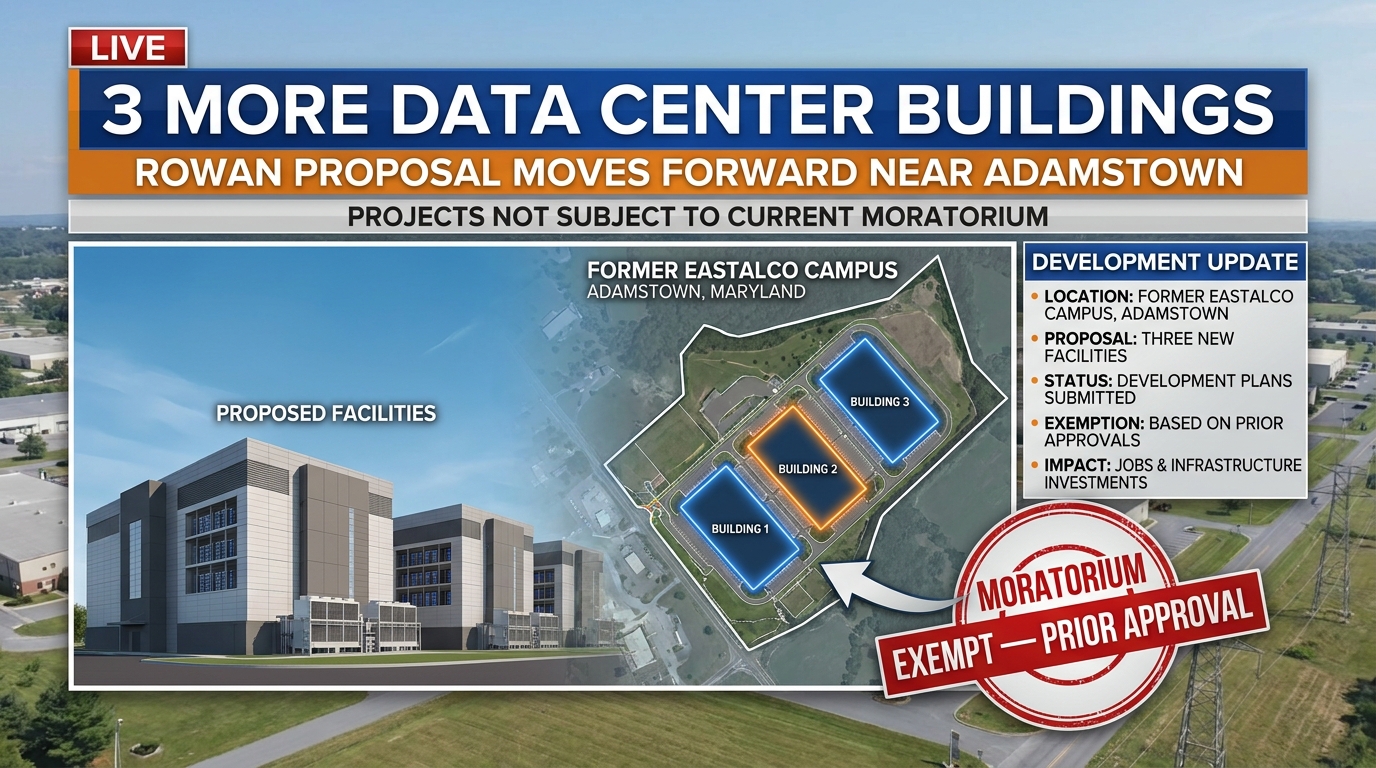

Frederick County records show Rowan NDA negotiations over Project Bauxite
Emails show Frederick County used its own NDA, accepted Rowan’s revisions and contemplated confidentiality across multiple County offices, while the released copy appears unsigned by the County.
HERE'S WHAT WE KNOW
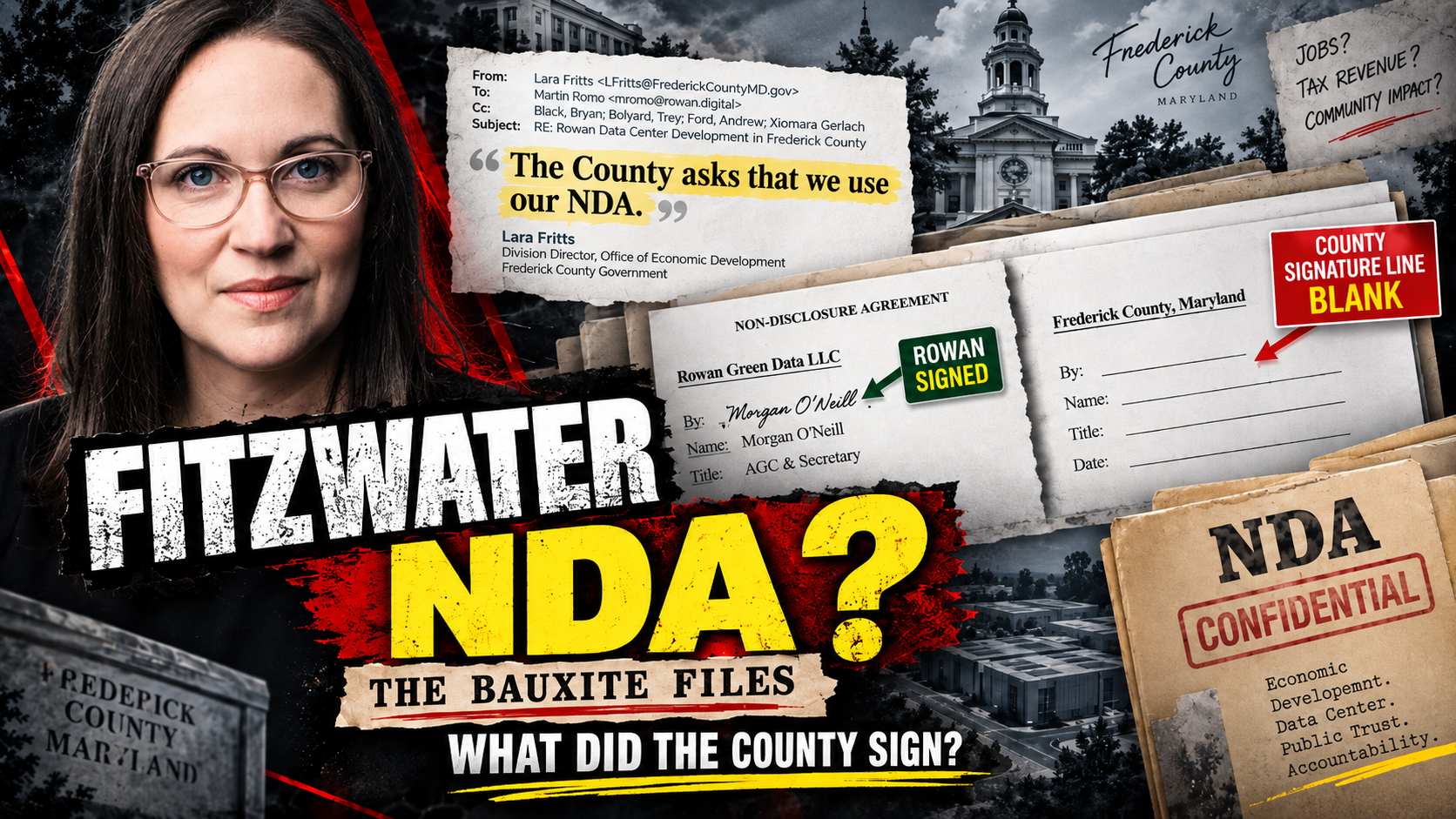
Frederick County officials negotiated an NDA with Rowan connected to Project Bauxite. The County proposed using its own NDA. County Attorney Bryon Black provided the agreement to Rowan. Rowan proposed revisions, and Black said the County was fine with them. Rowan later returned a version it described as “our signed NDA.” Attachment A contemplated confidential information being shared with 10 County offices, including the County Executive’s Office. The released copy contains a Rowan signature but appears to have a blank County signature line. The records do not show Jessica Fitzwater personally signing the NDA. The records do not conclusively establish that Frederick County executed the released version of the agreement.
A newly obtained set of internal emails and legal documents is raising new questions about how Frederick County handled confidentiality surrounding a major data center development tied to Rowan Digital Infrastructure.
The records, obtained through a public information request, document negotiations in 2023 over a non-disclosure agreement connected to a project identified as Project Bauxite.
The documents are notable because Frederick County currently states in its public data center FAQ that County Executive Jessica Fitzwater “has not signed any non-disclosure agreements related to the Quantum Frederick project and will not sign any such agreements.” The County continues to make that statement in its transparency section on data centers.
Nothing in the records reviewed by Everything Frederick shows Fitzwater’s signature on the NDA.
But the documents do show that Frederick County officials were actively involved in negotiating a confidentiality agreement with Rowan, that the County proposed using its own NDA, that the County Attorney accepted changes to that agreement, and that the proposed confidentiality structure contemplated multiple County departments — including the County Executive’s Office.
The biggest unresolved question is whether Frederick County ever fully executed the agreement.
The paper trail begins with Rowan representative Martin Romo, who told County officials that the company had a potential tenant for its data center project and needed to discuss matters involving infrastructure and County services.
Because a lease had not yet been executed and the tenant information was considered sensitive, Romo asked whether the County would agree to an NDA so the parties could discuss the project more freely. The correspondence also indicates that Romo suggested the County Executive could potentially execute the agreement.
Frederick County did not simply agree to use paperwork supplied by Rowan.
Instead, an email from the County’s economic-development side states:
“The County asks that we use our NDA.”
The email brought County Attorney Bryon Black into the discussion to provide the document. A subsequent message from Black told Rowan:
“The County’s NDA is attached for your and your tenant’s review.”
Rowan’s attorneys then reviewed the County document and proposed changes characterized in the correspondence as minor redlines.
On Sept. 19, Black responded:
“The County is fine with your changes.”
The following day, Romo sent another email referring to the attachment as:
“our signed NDA.”
The resulting agreement identifies the Frederick County Office of Economic Development as the recipient of confidential information and refers to the development by the code name Project Bauxite.
Rowan later publicly identified Bauxite as its data center development at the Quantum Loophole campus in Frederick County. In January 2024, Rowan announced that the Frederick County Planning Commission had approved a site development plan for a planned 777,151-square-foot hyperscale data center north of Adamstown.
But the confidentiality structure described in the records did not stop with Economic Development.
The emails show Romo asking whether another NDA would be needed to cover additional County divisions outside Economic Development, including Public Works and Planning. Black responded that Schedule A was intended to capture other County personnel who might need access to the information.
Attachment A lists 10 County offices or departments that could potentially receive confidential information: Planning and Permitting, Public Works, Water and Sewer Utilities, Energy and Environment, Fire and Rescue Services, the Sheriff’s Office, Solid Waste, Emergency Management, the Health Department and the County Executive’s Office.
The appearance of the County Executive’s Office on that list does not establish that Fitzwater personally signed the agreement, personally received confidential information or personally agreed to its terms.
What it does establish is that the proposed confidentiality structure specifically contemplated the County Executive’s Office as one of the offices that could potentially receive information covered by the agreement.
The NDA itself also defines confidential information broadly.
The language encompasses traditional categories such as trade secrets, technical information and financial information, but it also extends to information concerning discussions with the company, proposed terms, the status of the transaction and the fact that confidential information had been provided.
The agreement also addresses Maryland’s Public Information Act.
According to the records, if the County received a public records request involving information potentially covered by the NDA, Rowan was to be notified so the company could take steps to protect information it believed should not be disclosed.
That provision did not override Maryland public records law. The agreement recognizes that information required to be disclosed by law could still be released.
But it did create a process in which Rowan would receive notice before potentially confidential information was disclosed.
Another section addressed public statements about the project.
According to the records, Section 5 states that, except where disclosure was required by law, the recipient was not to issue a press release or make a public announcement or statement concerning the contemplated transaction without the company’s prior written consent.
Then comes the biggest unresolved issue in the records: the signatures.
Rowan’s Sept. 20 email refers to the attachment as “our signed NDA” and discusses whether additional County representatives listed in Attachment A would need to sign individual acknowledgement forms before the agreement became fully effective.
The copy released through the public information request contains a signature on Rowan’s side.
But the Frederick County signature line in the released copy appears blank.
The Attachment B acknowledgement forms associated with individual County representatives also appear blank in the documents provided.
That distinction is critical.
The records show that Frederick County officials negotiated the agreement, supplied the County’s NDA framework, reviewed Rowan’s proposed changes and accepted those changes. They also show Rowan signing and returning the document.
But the released copy does not conclusively establish that Frederick County fully executed that exact agreement.
It is possible that another signed copy or separate signature page exists and was not included in the records provided. It is also possible that the agreement was completed through another process, or that it was never ultimately executed by the County.
The documents reviewed so far do not answer that question.
That leaves a broader transparency issue.
Frederick County’s current statement that Fitzwater has not signed an NDA related to Quantum Frederick can be literally true while still leaving unanswered questions about confidentiality arrangements involving other County officials or departments.
The records obtained by Everything Frederick show that County officials did participate in negotiations over an NDA with Rowan, that the County chose to use its own agreement, that its attorney approved Rowan’s proposed changes and that the structure contemplated sharing confidential information across a number of County departments, including the County Executive’s Office.
What the records do not yet establish is who, if anyone, ultimately signed on behalf of Frederick County, which County employees actually operated under the agreement or whether another fully executed version exists.
Those questions remain unanswered.
WHAT IT MEANS
The records broaden the transparency question beyond whether the County Executive personally signed an NDA.
Frederick County’s current public position remains that Fitzwater has not signed a non-disclosure agreement related to Quantum Frederick and will not sign one.
The newly obtained documents do not disprove that statement.
What they do show is that County government itself participated in negotiating a confidentiality agreement with Rowan and developed a structure that could have involved multiple County departments.
The unresolved issue is whether that agreement ever became fully operative — and, if it did, who signed it for the County and who actually received confidential information under it.
What Still Needs to Be Answered Was the Project Bauxite NDA ultimately executed by Frederick County? If so, who signed it on behalf of the County? Which County employees signed acknowledgement forms? Which departments actually received confidential information? Did the County Executive’s Office receive information under the agreement? Does another fully executed version exist? Were similar agreements used with Rowan, Quantum Loophole or other data center developers?
Want more Frederick updates like this?
Get local alerts, event reminders, restaurant openings, sports news, giveaways, live show updates, and community stories from Everything Frederick. Want to talk about what’s happening? Join the Frederick Connect community too.