

Frederick council debates taking final say on selected major site plans
Peter Brehm’s proposal would let elected officials assume final review of certain applications, drawing concerns about delays, duplication and political influence.
HERE'S WHAT WE KNOW
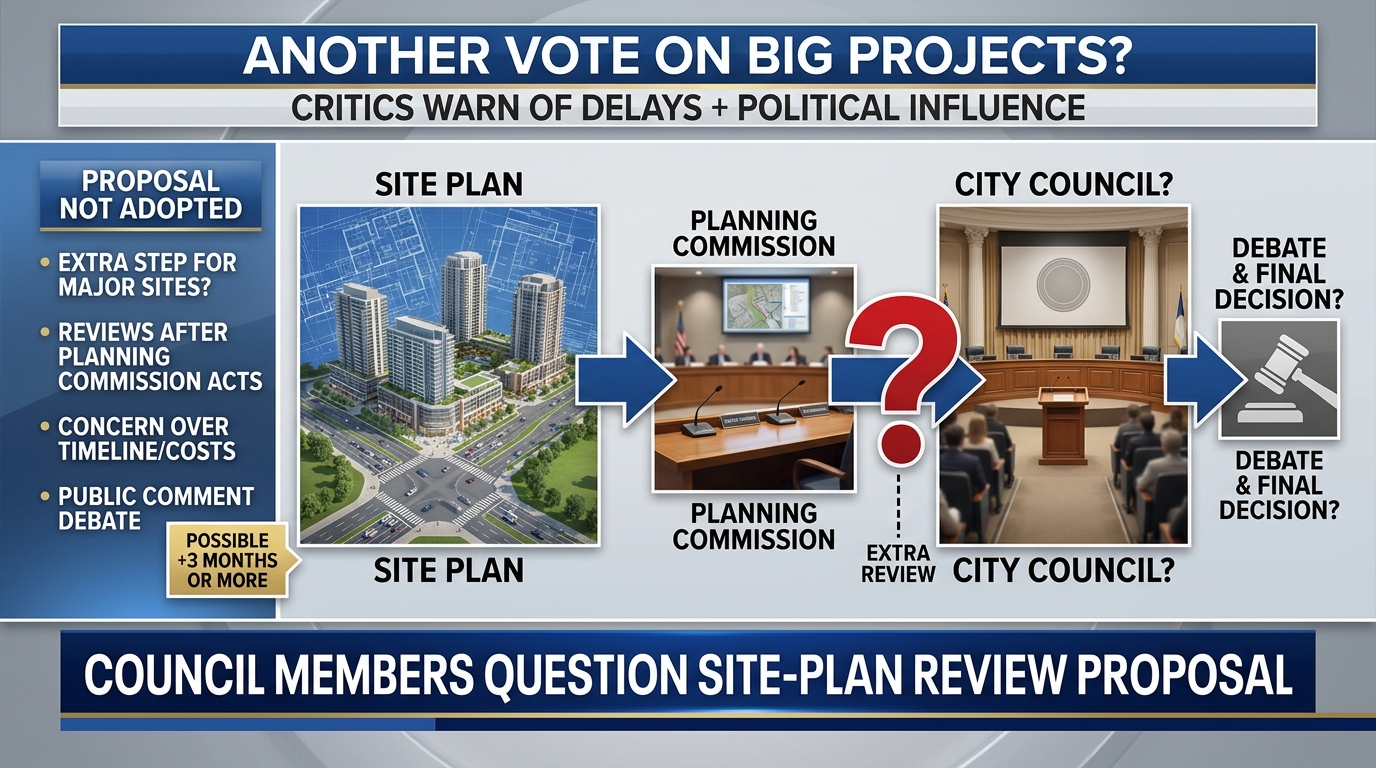
Brehm presented the proposal at the Sept. 24 council work session. The draft would let the council assume final review of selected major site-plan applications. The Planning Commission would remain the default reviewer and make recommendations on council-selected cases. Council members raised concerns about workload, duplication and political influence. The proposal was not reported as adopted.
A proposal to give Frederick’s elected City Council final authority over selected major site plans drew questions Sept. 24 about political influence, additional work and longer development reviews.
Council Member Peter Brehm brought the idea to a work session for feedback before seeking a formal Planning Commission recommendation, according to The Frederick News-Post.
The proposal follows questions about traffic associated with a proposed cricket stadium along East Patrick Street. The council approved rezoning for the property in August, but detailed site-plan information would arrive later in the development process.
Brehm argues that elected officials should have a role when those details become available, rather than leaving the final site-plan decision solely to the appointed Planning Commission.
The draft amendment posted with the city’s meeting materials explains how that role would work. The Planning Commission would remain the default reviewing authority. Within 60 days of notice that an application had been submitted, the council could vote at a public meeting to assume final review of that application.
For a case selected by the council, the commission would review the proposal and send a recommendation rather than issue the final decision. The draft gives the council 30 days after transmission to approve, approve with revisions or deny the application. If the council did not vote within that period, the commission’s recommendation would become the final decision.
These provisions are proposed language, not an adopted change to the process.
Council Member Derek Shackelford questioned the need for an additional decision-making step. The council already writes the Land Management Code that governs the commission’s review, he said, and elected officials could be more vulnerable to political pressure.
City Attorney Rachel Gray explained that a council review would still have to apply the same standards in the code. Giving the council another role would not remove those requirements.
Council Member Joe Adkins, who previously worked in the city’s planning department, said the change would require training, more public meetings and additional staff work. He estimated it could add about three months to approvals, conflicting with efforts to shorten the process.
Adkins suggested that a broader review of the Land Management Code might give the council a better way to address its concerns. Shackelford also expressed interest in using the code rather than making additional decisions on selected projects.
Another possibility raised by Adkins was restoring a voting council representative to the Planning Commission. Shackelford said the former Board of Aldermen had removed that arrangement to reduce political pressure and repetitive voting.
Council Member Sarah Hempel Irani asked whether Brehm had examined how other cities handle the issue. He said he had not yet done that research. Council President César Díaz asked questions without stating a position; Vice President Katie Nash and Council Member Libby Taylor were absent, the News-Post reported.
During public comment, former Frederick County planning director Eric Soter warned that another discretionary approval could create uncertainty. He estimated delays could reach six to nine months and praised the city’s existing neighborhood meetings and commission work sessions as opportunities for public participation.
The differing delay estimates are predictions offered during the discussion, not established timelines. The supplied account does not report adoption of the amendment.
WHAT IT MEANS
The debate concerns who makes the final decision on detailed development plans after zoning decisions have been made. Additional elected review could change that responsibility, but it would not free the council from the city’s development standards. The draft’s potential effects on timing and public participation remain contested.
Original reporting referenced by Everything Frederick:
The Frederick News-Post — Reporting by Katelynn Winebrenner, from the supplied news file. Additional verification: City of Frederick Sept. 24, 2026 agenda and draft major site-plan amendment. →Want more Frederick updates like this?
Get local alerts, event reminders, restaurant openings, sports news, giveaways, live show updates, and community stories from Everything Frederick. Want to talk about what’s happening? Join the Frederick Connect community too.