
FCPS board narrows possible student AI ban to younger grades
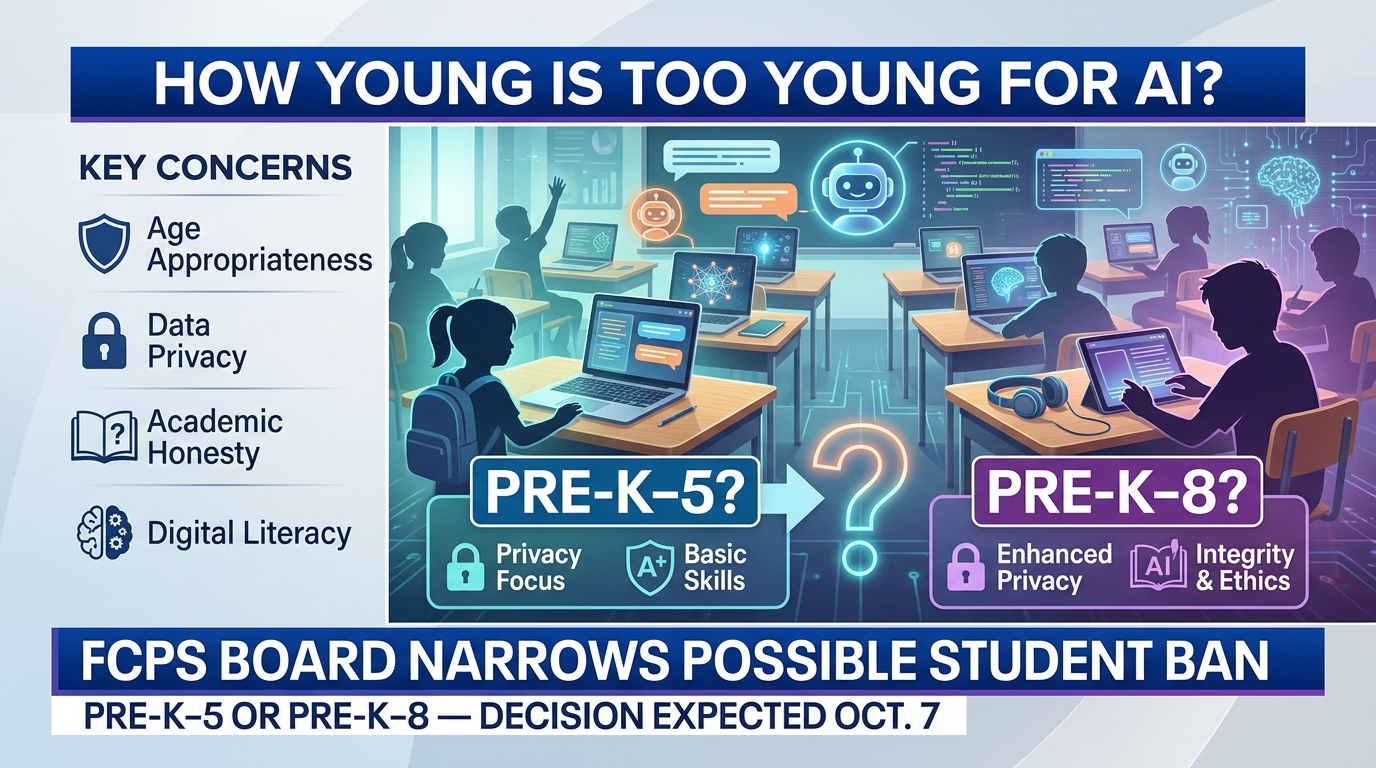
The Frederick County school board has ruled out a total student AI ban and will next consider restrictions covering either pre-K through fifth grade or pre-K through eighth grade.
HERE'S WHAT WE KNOW
FCPS has ruled out a total AI ban for all grade levels. The remaining options are restrictions for pre-K through grade 5 or pre-K through grade 8. AI-literacy instruction would still be treated separately from unrestricted student use. Board members differ on how far restrictions should extend. The draft policy says AI should never replace educators. It would prohibit AI use for bullying. FCPS currently pilots Google Gemini for middle and high school students within its secure environment. Policy 124 was first presented publicly Sept. 9.
The Frederick County Board of Education has ruled out a districtwide ban on student artificial intelligence use and is now considering restrictions focused only on younger students.
Board members said Wednesday that their remaining options are an AI ban for pre-K through fifth grade or one extending through eighth grade.
The board is scheduled to review its proposed AI policy again during an Oct. 7 work session, when members are expected to continue refining the grade-level restrictions.
FCPS confirms that the district is currently developing its first overarching AI policy in response to new Maryland requirements.
The discussion does not mean that all instruction involving artificial intelligence would be prohibited for younger grades.
Board members distinguished between unrestricted student AI use and AI literacy instruction supervised by teachers, including lessons designed to help students understand how AI works, evaluate its output and use it safely.
Several board members entered the meeting with different preferences.
Karen Yoho and Colt Black initially favored a ban for all students.
Board President Dean Rose, Vice President Rae Gallagher and board member Chad King Wilson Sr. initially favored a pre-K-through-fifth-grade ban.
Janie Inglis Monier and Jaime Brennan initially supported extending the ban through eighth grade.
Some positions shifted as the discussion continued.
Yoho said she became open to a pre-K-through-fifth-grade approach after hearing other board members.
Gallagher said she had also initially favored broader restrictions but changed her view after learning about potential educational applications, such as helping students organize or review notes.
Monier said AI can have value when it assists students in processing information instead of simply producing answers.
Brennan said she saw potential value in note-taking applications but remained skeptical about broader student use.
Black disagreed with using AI for notes and argued that handwritten note-taking remains more educationally effective.
Rose said one of his concerns with a broad ban is ensuring students are prepared for a workplace in which artificial intelligence is likely to be widely used.
FCPS currently says it is taking a “measured, strategic approach” to AI. The district is piloting Google Gemini for middle and high school students within its secure digital environment while continuing AI-literacy instruction and operating under an “assume no AI” approach unless teachers authorize its use.
The proposed policy has also become more cautious in tone.
Board members approved language stating that AI must not replace educators and prohibiting AI use for bullying. The draft also warns of risks involving privacy, bias, equity, academic integrity and over-reliance on automated systems.
The policy continues to require that AI use serve legitimate educational or operational purposes, protect students and staff, maintain data security and comply with state and federal law.
FCPS says the policy work is being driven in part by Maryland’s Artificial Intelligence Ready Schools Act, which took effect June 1 and requires school systems to develop AI policies and provide AI-literacy education.
WHAT IT MEANS
The debate has shifted from whether FCPS should ban student AI entirely to how young students should be before they are allowed access under school rules.
Board members are trying to balance concerns about cheating, over-reliance, privacy and student development against the possibility that responsible AI use will become an increasingly important academic and workplace skill.
The final grade-level cutoff will be one of the most significant decisions in the district’s first formal AI policy.
What Happens Next
The Board of Education is expected to take up the policy again during its Oct. 7 work session.
The district is working under a state requirement to establish a formal local AI policy this fall.
Original reporting referenced by Everything Frederick:
The Frederick News-Post — Reporting by Sarah Rubinstein; Frederick County Public Schools →Want more Frederick updates like this?
Get local alerts, event reminders, restaurant openings, sports news, giveaways, live show updates, and community stories from Everything Frederick. Want to talk about what’s happening? Join the Frederick Connect community too.