
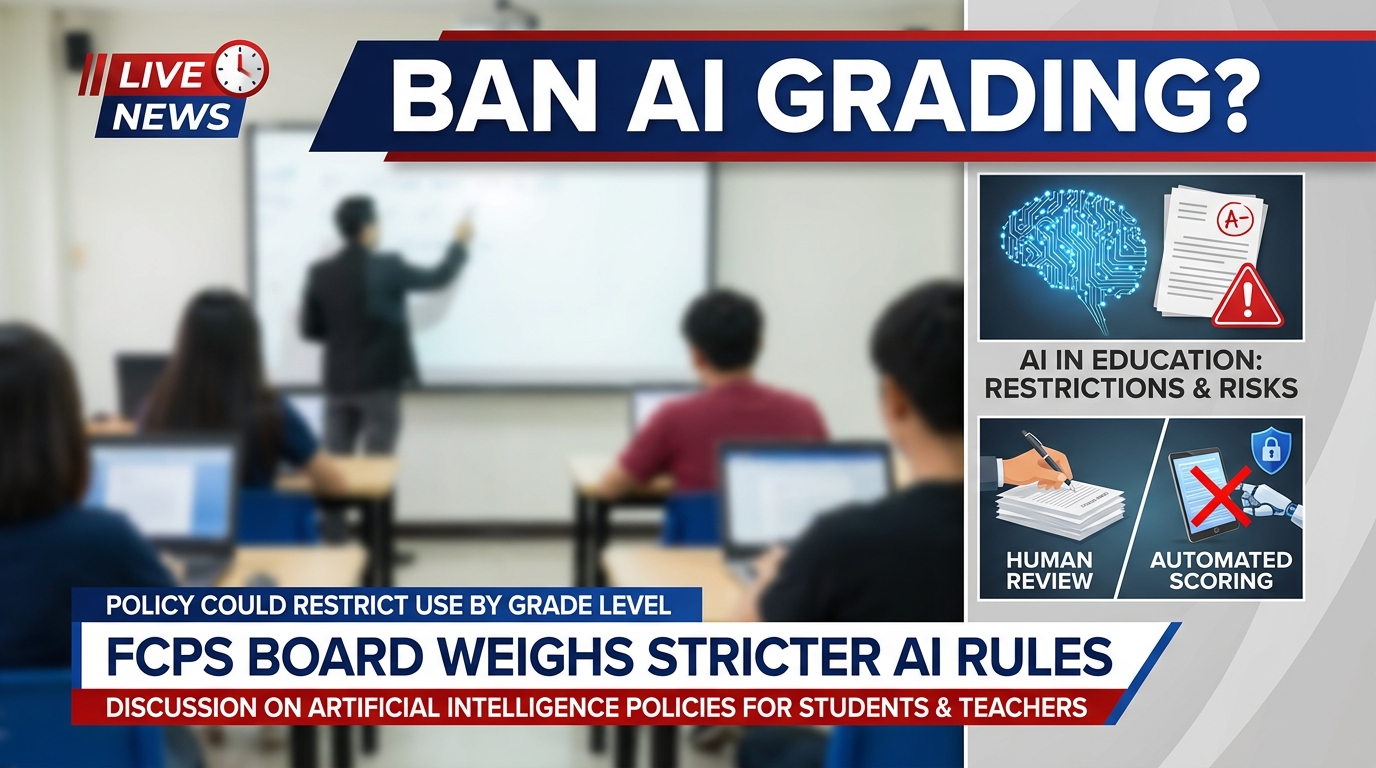
FCPS considers banning AI grading and restricting student AI use by grade level
Frederick County school board members are considering significant changes to the district’s first formal AI policy, including a ban on AI grading and tighter limits for younger students.
HERE'S WHAT WE KNOW
FCPS is developing its first official artificial intelligence policy. The policy is moving to a second board review. Board members are considering an explicit ban on AI grading student work. The board may also restrict AI use differently by grade level. A student survey found 58% of respondents opposed student AI use and 64% opposed teacher AI use. Other board members want to preserve AI tools that may help teachers with workload. Maryland enacted the Artificial Intelligence Ready Schools Act earlier this year.
Frederick County’s first formal policy governing artificial intelligence in schools could become significantly more restrictive before it receives final approval.
The Board of Education voted to advance proposed Policy 124: Artificial Intelligence to a second review while directing staff to develop several potential amendments, including a specific ban on using AI to grade student work and restrictions based on students’ grade levels.
FCPS confirmed that Policy 124 received its first reading at the board’s Sept. 9 meeting and will return for a second review.
The proposed policy currently states that artificial intelligence should be used only when it serves clear educational or operational purposes while protecting privacy, academic integrity and student and staff safety.
It would require human oversight and address issues including equity, data security, AI literacy, staff training, assessment and procurement of AI tools.
But board members are considering going further.
District legal counsel Steven Blivess said staff will prepare multiple versions for the board’s next meeting, potentially ranging from a full prohibition on AI use to different restrictions depending on grade level.
Student member Thora Mintz presented results from a 59-student survey representing every FCPS high school.
About 58% of respondents said students should not be able to use AI in school, while 64% said teachers should not use AI in school. Students opposing the technology cited concerns about plagiarism, critical-thinking skills and environmental impact. Supporters said AI can help students check work, better understand concepts and prepare for its use later in life.
Board member Jaime Brennan suggested allowing schools to teach students about AI while restricting its use for coursework. Brennan said AI education and coursework use should be prohibited for students in kindergarten through eighth grade, with high school students learning about the technology without necessarily using it for assignments.
Board member Chad King Wilson Sr. called for an explicit prohibition on AI grading and stronger language stating that technology will not replace educators.
Other board members cautioned against removing tools that some teachers already find useful.
Superintendent Cheryl Dyson said the district’s focus should remain on teaching and learning and that AI cannot replace the judgment and human connection provided by teachers and support staff. She also acknowledged that some educators and administrators are already using AI to reduce their workload.
Teachers and members of the public also weighed in.
Urbana High social studies teacher Aubrey Lynch called for a one-year moratorium on AI use in schools, while retired teacher and school board candidate Casey Day urged the board to specifically prohibit AI from grading student work.
FCPS is developing the policy as Maryland implements the Artificial Intelligence Ready Schools Act, which requires the state to create AI guidance and tools for local school systems. The legislation was approved by the governor in May as Chapter 634.
According to the source material, FCPS has until Oct. 22 to put its policy in place.
WHAT IT MEANS
FCPS is not simply deciding whether AI should exist in its classrooms.
The larger question is where the district draws the line between teaching students how artificial intelligence works and allowing students or teachers to use it to perform academic work.
A ban on AI grading would also establish a clear rule that human educators remain responsible for evaluating student performance.
The second review should provide a much clearer picture of how restrictive Frederick County’s final policy will be.
Want more Frederick updates like this?
Get local alerts, event reminders, restaurant openings, sports news, giveaways, live show updates, and community stories from Everything Frederick. Want to talk about what’s happening? Join the Frederick Connect community too.